Day 3 & 4: Partying and trouble shooting

Days 3 and 4 usually are more relaxed, compared to the first two days of the passage. The biorhythms get used to life at sea, which includes the continuous motion from the waves and the need for a day and night watch. With three adults on board, night watches get considerably shorter than for a couple only, what a luxury!

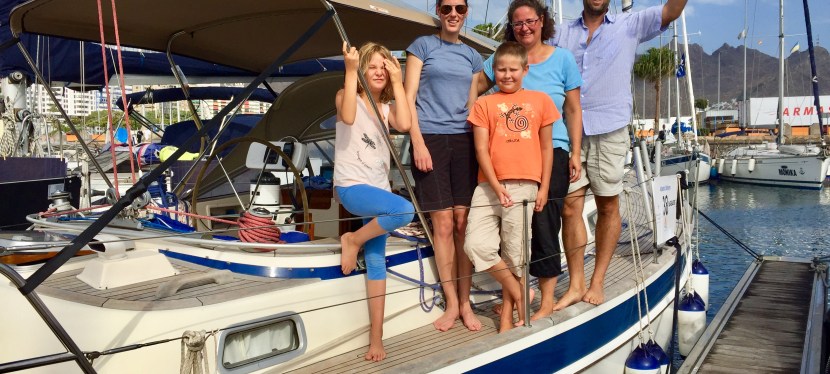
So we had more time for party: we celebrated the crossing of the 20st meridian which happened to be in the middle of the night. The boy set the alarm clock. At 4 a.m. sharp one pair of proudly looking kids eyes appeared at the cockpit. I welcomed him to the party and suggested to get properly dressed. The search for his clothes however made him so tired that he fell asleep again on the next bunk. So we’d better party during the day. To eat, kids choose popcorn and sour worms. Captain offered drinks and the ladies on board even made colorful paper decorations for it.

Later the same day Jeanette is the one who realizes that we are just about to pass the half way point to Mindelo. That calls for another great party, namely a Half Way Party (this is a thoroughly legendary term for some of my dear readers!). As we discuss to celebrate this one, we whiteness the fishing rod going all the way back. “Fish! Big Fish!” Our fishing line is really strong, the last meter even in steel so that fish can’t bite it off. The line is unfortunately not strong enough and snaps. You know what? Mr BigFish now carries a beautiful lip piercing. It is a bluish-silvery jelly octopus, contributed by Swiss blue water cruisers Carmen & Maurice. RIP, dear Jelly Octopus. You were the best lure we had. Dear Carmen, I believe to know that you really liked this particular octopus. When we will be back in Switzerland, we shall party for luckily pierced Mr BigFish. Apologies for the loss!

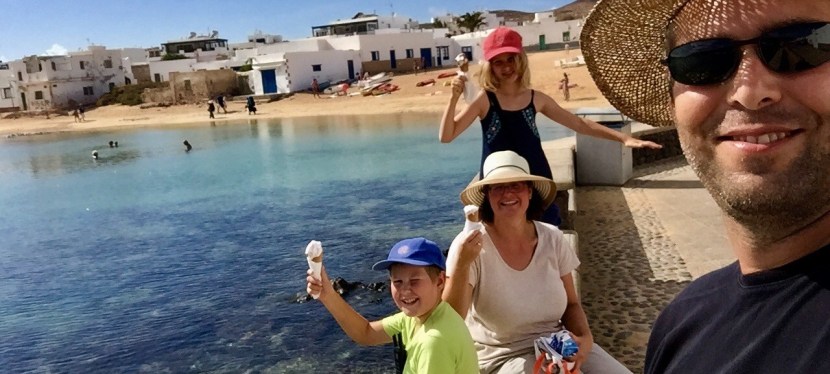
Noteworthy is also that we are back in Summer, on a day mid November. Day temperatures are like on a convenient beach day with water finally being up to 25 degrees C. It is hard not jumping into the deep blue. Problem is that the way back onto the boat could be troublesome (if not dangerous) with the boat rocking up and down in the seas. Anyway, no one on board misses typical November weather in our home places Switzerland and Sweden.

After we had a bird messing up to whole starboard deck last night we had his colleague sitting inside the boat on the galley this night. It must have come through the open hatch above the galley. Sure the galley gave a nice toilet for him. Markus was actually out on the watch when he heard some very uncommon noise inside. There was the bird, but the noise was like a cat which would continuously start to hiss. Chhhh. Chhhh. Chhhh. First I brought the bird out. It was weighing just nothing. Incredible how they can survive at sea. As expected the noise didn’t stop when the bird was away. Chhhh, Chhhh, Chhhh, … The engine room was ok, the water maker in the cockpit locker and the fridge as well. Finally we found that pressurized water hose underneath the galley board died after four month of use only, a manufacturing mistake. But why did hissing start and stop all the time? The puncture in the hose was relatively small, so small that the water pump was able to fill the pressure vessel for a few seconds each time. Good that we carry all kinds of spare parts, also water hoses. Issue fixed.

Another defect was that the position tracking for our boat failed shortly after we left. We could start tracking of the error only with a big delay. The cause of the error was that we had to re-configure the interface between our satellite communication system and the weather software. When doing that, the weather software has re-directed our tracking signal to the weather company. This remained undetected by myself since the setup for tracking is not in the same menu as the weather interface. Apologies to the ones who were frightened for some time. Please rest assured that everybody is fine and we have a great time together.

Let’s talk about sailing:
A sail change at three o’clock in the morning is quite a mind challenging task. Actually we took the Code Zero light wind sail down and changed to a poled out genoa. There were not less than eight different lines in the area. You don’t want to mess up with these ones, and one action which is not clearly thought to the end can easily trigger an unwanted event. Markus likes such tasks. The ladies however didn’t like seeing me on the foredeck at night with the waves rolling the boat.

To make it even nicer, we have reached a first sailing culmination for our entire trip so far. There were force 6 winds from astern and waves peaking up closely to 3 meters. For a couple of hours the boat was going really fast. We were often above 8 knots of speed, well competing which much faster boats. Another boat remarked their respect about our sailing performance over the VHF radio. We put it down to our nice Swedish Hallberg-Rassy design and the Swedish sail trimmer. Once Yuana was even doing 11.2 knots when surfing down a wave. The boat felt so stable and kind of unaffected by the waves. It was a big pleasure, and the weather gods may be kind enough to give us more of that!

Data log
Day 4: 150nm
Day 3: 148nm
Day 2: 126nm
Day 1: 134nm
Von Teneriffa in die Kapverden – Tag 2

Unsere Tage fangen Mittags um 11:30 Uhr Lokalzeit an. Das war unsere Abfahrtszeit in Santa Cruz de Tenerife ausgelaufen sind. Segler erfassen immer das sogenannte Etmal, nämlich die in 24 Stunden zurück gelegte Distanz.

Das Etmal des ersten Reisetages betrug 134 Seemeilen. Am zweiten Reisetag (von Sonntag auf Montag) legen wir bei schwachwindigen Verhältnissen mit etwas Motorsegeln immerhin noch 126 Seemeilen zurück.

Der Sonntagnachmittag bringt das zweite gute Segelerlebnis innert 24 Stunden: Nachdem am Vortag bereits das Ausbaumen der Genua die Geschwindigkeit auf ein akzeptables Niveau gehoben hat, ist nun auch der erste Einsatz des Leichtwindsegels ‚Code Zero’ ein toller Erfolg: bei 10 Knoten Wind macht die schwer beladene Yuana immer noch gut 6 Knoten Fahrt. Abends werden die Winde leichter. Markus wird jeweils nervös, wenn die Logge eine Geschwindigkeit mit einer 4 vor dem Komma zeigt. Wenn die Geschwindigkeit unter 4 Knoten fällt, starten wir den Diesel. Am Sonntagabend ist es soweit, und so machen wir nachts mit dem Dieselwind Meilen, Wasser und Strom.

Wie auch schon am Sonntag gibt es am Montagmorgen einen diessig-gelben Himmel zum Sonnenaufgang. Das Licht erinnert mich an Indien oder China. Es ist der Sirocco, der den gelben Wüstensand herüber zu uns trägt. Sämtliche Wanten, Relingsdrähte und Leinen und selbst die dünne Angelschnur sind auf der Luvseite braun. Da bekommt der Begriff ‚Wüstenschiff‘ plötzlich eine neue Bedeutung.

Am Montagmorgen ist die See ist flach und der Wind wird besser. Hoffentlich können wir unsere Durchschnittsgeschwindigkeit noch etwas anheben. Dann kämen wir innerhalb der sechs Tage an, und hätten mehr von den Kapverden.

Tenerife to Cape Verde – Day 1

Fog horns were operated and many hands waved us good bye as we left Marina Santa Cruz. Thank you dear friends, it was so nice
seeing you on the harbor jetty, cheering to the start of our six days leg down to Cape Verde.

Rolling waves meet us as we get out of the harbor. As we want to set sail, we rip off the the flag decoration which was going from the bow over top and down to the stern. Later on same day we got more sport exercise on deck when piling out the genoa. That helps greatly to have that sail filled best with wind. The waves continued to roll us through the first night on sea.

Next morning we have even more motion in the boat. Two overlapping wave systems with the peaks reaching into 3 meters keeping us busy when doing meals or dishes. Most of our friend boats are well ahead of us and even out of electronic sight. The two French catamarans INFINITY and LUNA BAY simply can do a different pace. And the 15 meter long ROGUE showed us how sailing goes. Josh the skipper cruises racing boats and super yachts by profession.

Shortly before noon, our first 24 hours are done. We did 134 nautical miles. Our new crew Jeanette contributed some of these miles. Her regatta experience in sail trimming is of great help to us.

Later on wind drops. We roll the genoa away and for first time ever hoist our code zero sail. This is like an enlarged genoa, made of light fabric. First use of that nice sail gives us a nice occasion to celebrate. The skipper can offer either warm Coke or warm Fanta. Both is appreciated and we are heaving fun as we relax our way down to Cape Verde.

[via satellite, picture to follow]

Ab in die Kapverden!

Es ist der 11. November 2017 und der Tag, an dem unser transatlantisches Segelabenteuer startet. Es ist auch der Tag, an welchen P&K zu Hause ihren 45. Hochzeitstag feiern. Herzlichen medialen Glückwunsch!

Seit drei Tagen ist Jeanette aus Schweden bei uns an Bord, und sie hat uns bei der Erledigung der letzten Pendenzen super mitgeholfen.

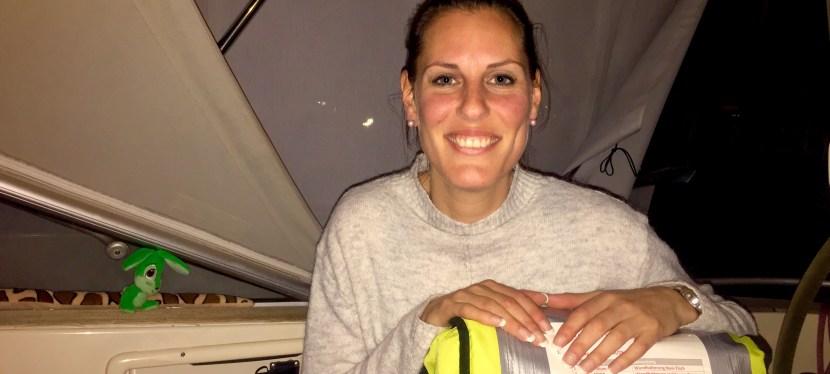
Jeanette hat für uns die Grab Bag gepackt. Das ist die Tasche, in welche man alle Dinge steckt, welche man im unwahrscheinlichen Falle eines Schiffsverlustes auf See mit auf die Rettungsinsel nimmt. Darin befinden sich z.B. auch die Reisepässe, Signalraketen und eine Sicherungskopie der elektronischen Daten. Jeanette hat die wichtige Rolle, diese Grab Bag im Falle des Falles mit auf die Rettungsinsel zu nehmen.

Manuela hat gehaushaltet wie verrückt, alle Textilien nochmal gewaschen, und zwei Zentner an Lebensmitteln gekauft und eingeräumt. Zum Glück sind darunter auch viele Flaschen Wein, welche hier gut und günstig und in der Karibik sehr teuer sind. Nicht zuletzt hat Manuela einige Mahlzeiten vorgekocht, so dass wir die ersten Tage auf See nur möglichst wenig Zeit unter Deck in der Küche verbringen müssen. Ausser den Vorräten in der Küche wurden natürlich auch Wasser, Diesel und Gas gebunkert.

Markus hat derweil nochmals die ganze Technik an Bord durchgecheckt. Die bisher nicht immer zuverlässige Satellitenkommunikation wurde neu aufgesetzt. Die Crew hat eine tiefgehende Sicherheitseinweisung erhalten. Beim Skippers-Briefing wurden Aus- und Einreiseformalitäten besprochen, und es wurde auch nochmals auf die Risiken der schnell wechselnden Winde im Südosten von Teneriffa aufmerksam gemacht. Diese Winde sind unkritisch wenn man sich der Situation bewusst ist. Wir werden das bereits vor dem Eindunkeln heute bewältigt haben.

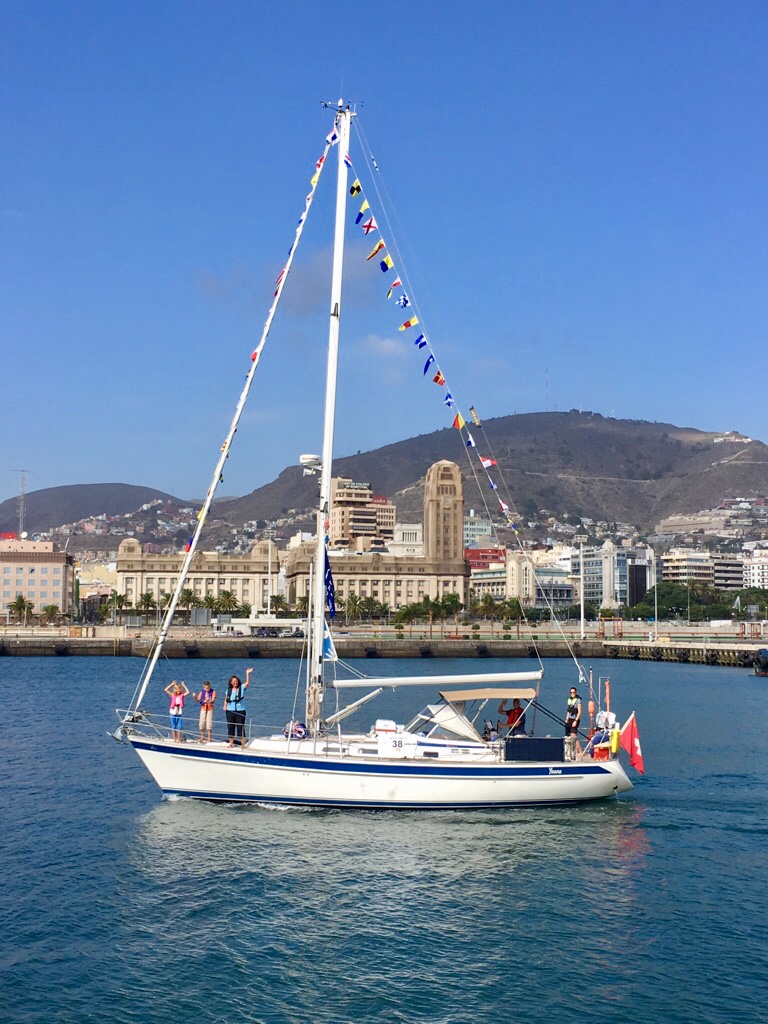
Die Kinder haben die Signalflaggen zusammengeknüpft und das Schiff ‚über Topp‘ beflaggt, siehe Bild. Unter den vielen anderen Kiddies im Hafen haben sie schon liebe Freunde und Freundinnen gewonnen. Besonders toll ist, dass beide anfangen, mit ihren neuen Kollegen ihre Englischkenntnisse einzusetzen!

Wir sind nicht alleine unterwegs. Von Teneriffa zu den Kapverden werden wir in einer Gruppe von acht Schiffen segeln. Etwa sechs Tage wird die Überfahrt dauern. Während dem Zwischenstopp in Mindelo stossen 17 Schiffe zu uns, welche schon vor zwei Woche in Teneriffa gestartet sind und seither in den Kapverden gesegelt waren.

Diese Gruppierungen kommen daher, dass wir uns bei Cornell Sailing angeschlossen haben. Das ist ein Veranstalter für Touren auf dem Meer, so wie man andernorts Bergtouren buchen kann. Auf See ist man relativ alleine unterwegs. Jedoch haben sich einige Crews schon vor Monaten in Spanien oder Portugal kennengelernt. Hier auf Teneriffa haben wir mit der Hilfe des in der Seglerszene berühmten Jimmy Cornell und seinem Team diverse sicherheitsrelevanten Themen abgehakt. Sodann haben wir uns mit allen Crews bekannt gemacht und zusammen viel Spass gehabt. Es ist wichtig, sich zu kennen, denn wer sich kennt, der hilft sich auf See, so gut es geht.

Die Nachttemperatur ist in den letzten Tagen unter 20 Grad gefallen. Es wird also Zeit, dass wir weiter ziehen, diesmal gut 10 Breitengrade Süd. In den letzten Monaten haben wir viel Vertrauen in unser Schiff gewonnen. Das ist sehr wichtig, um beruhigt und zuversichtlich in See stechen zu können. Das Schiff ist nun bereit für den nächsten grossen Sprung. Der Skipper und seine Crew sind es auch. Die Seewetterbedingungen für die kommende Woche sind normal bis optimal.

Man kann im unten stehenden Link unsere aktuelle Position einsehen. Unsere Ralley ist keine Regatta, und unsere Yuana nicht die längste im Feld (aber selbstverständlich die Beste). Daher werden wir bei weitem nicht zuvorderst fahren.

Während der Fahrt auf die Kapverden versuchen wir, täglich ein kurzes Updates posten.

Auf dem Bild sieht man übrigens unser Schiff beim Auslaufen aus dem Hafen von Santa Cruz de Tenerife.

https://cornellsailing.com/sail-the-odyssey/atlantic-odyssey/ao-2017/track-the-boats/

Foto: von S/Y KISU, besten Dank!!

F37A3137-A92D-47BC-AE88-B130FD4EA4DD

Getting ready, with new crew

So this is Jeanette, writing my first blog post for Yuana, as I will join as crew form the Canaries via Cap Verde to the Caribbean. As I got here ‪Tuesday night‬ there was a really some thunder and lightning, not really what I expected! But it turned out I arrived the perfect night as I walked right into the potluck dinner. So before even leaving my bags on the boat I got to meet everybody, having dinner and some wine, feeling very welcomed from the first minute. Some people you feel comfortable with just from the start, that is exactly how it felt for my meeting the Yuana’s, everybody was super-friendy! Altough understanding the Schwiitzerdütsch was a little more complicated than I thought before…

It seemed getting here four days in advanced was a lot of time, but we have really been busy since. Lots of small things to fix and get in order and evening getting by with dinners together with the crew of other boats. Also yesterday there was a guided day tour to the Teide volcano that we all took. After we were just in time for the seminar with Jimmy Cornell talking about tactics for the crossing. Today me and Manuela went for the big food shopping, imagine almost two hour in a grocery store! But fortunately they bring all your food all the way to the dock for you, very nice service. So we could rush on to the farewell party at the yacht club, which was really nice arranged. Now we just finished stuffing everything in its place and hopefully tomorrow we will have a bit of rest until we set off, which should be around lunchtime. I think by now we all look forward to set off for Cap Verde!

Jetzt kommts richtig übel

Eigentlich wollten die Jungs mit dem Beiboot Dorie für eine kreative Mathestunde an Land übersetzen. Der Plan war, eine kleine Wanderung zu machen, schöne Fotos zu schiessen, und spielerisch das Einmaleins zu vertiefen.

Papa’s Schritt von Yuana zu Dorie erweist sich jedoch als fatal. Irgendwie haut Dorie ab, und Markus landet im Wasser. Das wäre kein Problem, hätte ich Handy und die neue Fotokamera wie sonst immer in den wasserdichten Beutel gepackt hätte. Um es kurz zu machen: Die neue Kamera zuckt noch einige Sekunden, das iPhone ist sofort tot.

Das Schlimmste ist, dass Markus in den frühen Morgenstunden auf dem Handy noch zwei Artikel für den Blog geschrieben hat. Diese sind nun im Salzwasser ersäuft worden. Weil es hier in der Bucht kein Mobilfunk gibt, wurden von den neuesten Daten noch keine Sicherung erstellt.

Was ich mir zuvor nicht vorstellen konnte ist, wie sehr der Verlust des iPhones schmerzt. Brutal erkenne den nächsten Schritt der Evolution: du brauchst ein iPhone dringlicher als ein schönes Auto. Du nimmst dafür sogar in Kauf, kurzsichtig zu werden. Die meisten werden nun wohl entweder lachen oder den Kopf schütteln. Bitte bedenke:

Ich kann nun
– Nicht mehr aufschreiben, sobald mir eine coole Idee für den Blog kommt
– Keine Schnappschüsse mehr machen
– Nicht mehr mit Familie und Freunden e-mailen
– Nicht sehen, wo sich unsere befreundeten Schiffe befinden
– Unsere Seglerfreunde nicht über WhatsApp kontaktieren
– Nicht mehr auf unsere Satellitenanlage zugreifen
– Keine Wetterberichte einholen
– Kein Auto mieten und keine Strassenkarten nutzen
– Kein Wikipedia-offline nutzen
– Keine Bankzahlungen tätigen
– Weder NZZ noch Bluewin lesen
– Telefonieren geht nicht, und Musik hören auch nicht
– Der Taschenrechner ist weg, die Uhr und die Taschenlampe sowieso
– Nicht nachschauen, wann unsere Crew aus Schweden eintrifft

Caramba! Versteht ihr jetzt die Dimension des Problems? Wir müssen sofort aus der schönen Bucht mit schwarzem Sand raus und nach Santa Cruz de Tenerife hinunter, damit ich mit ein neues iPhone beschaffen kann. Mal sehen, wie wir das abbuchen werden. Für Dummheit hatten wir bisher nämlich keinen Budgetposten vorgesehen.

Das Schulreisli in die Kaktusberge hat natürlich trotzdem stattgefunden. Zum Glück war der Sohn dabei, denn so konnte mir jemand den Stachel aus der Zunge ziehen, nachdem ich die Kaktusfrucht probiert hatte. Alleine hätte ich das ohne Selfie-Modus nie geschafft.


PS.: Auf dem Weg nach Santa Cruz telefonierte ich mit dem Sorgentelefon von Apple. Die sagten mir, dass ich nach dem Wochenende in Santa Cruz ein neues iPhone zum Preis von 351 Euro abholen könne, 50% des Ladenpreises. Das wäre ein hervorragender Service. Wir werden sehen, ob das auch klappt.

Harboring the Canaries

The last 12 hours on our way from Madeira into the Canaries were quite exhausting. We made a decent progress, in rolling waves and against the wind. Some salty drizzles went over the cockpit every now and then. The outer deck however saw a lot of sea water. Somehow, approximately 50 liters of the salty liquid ended up in the bilge, which is the deepest point INSIDE the boat.

The 50 liters itself wasn’t too much of an issue, but the fact that salt water gets into the boat is definitely unwanted. Skip this section if you are not interested in technical terms. Our cockpit and part of the deck are drained via reinforced hoses through the interior of the boat and out underneath the water line. Shorty after buying the boat I checked and fastened all of the hose clamps which secure these hoses, each one going from a hose sleeve below deck down to a valve, before going into the sea. Somehow, I must have missed one of these hose clamps, certainly the one which came loose, draining some deck water into the bilge. Item solved.

Arriving in the Canaries, we anchored in famous Francesa Bay. As many places, it has unveiled their beauty to us only after a day or two: its underwater world. The first day in the anchorage was tough again: 35 degrees Celsius at 35 knots of wind and 1 meter swell in the anchorage. Not a good anchorage on that day indeed. Anyway, we wanted to be there because it is a nature reserve and we got a special permit to be there. The good news is that our anchor held rock solid, but two anchor retention lines (the lines taking the load off the anchor winch) broke due to the heavy rocking of the boat.

Two days later and in the port of totally dry island of Graciosa, we found ourselves in a very little village, all houses painted white, with sandy lanes in between. There were only two hands full of cars for the entire village. A horse wagon on a restaurant roof reminded of the old days. During the weekend, the place was looking like a neat hippy village, with dreadlocks men and women trying to make some bucks with selling nice hand craft. Customers however seemed to be not too many.

On Graciosa and a week later on Lanzarote, we got more of the volcano stuff all over the place. In the cactus gardens we learned that the saying ‘hard shell soft core’ really can also be the other way round: some of the huge cactus were cut back. There we spotted that those cactus have a core hard as wood, packed into a relatively soft shell. Then there was the camel ride. We not only rode these fantastic animals, we also took a deep look into their eyes: most of them seamed to be good-natured. But there was one really mean looking chap, perfectly prepared for the Horror Rocky Camel Show.

More animals? Yes. When kissing our friends from yacht Tomskii Kastan goodbye, Markus learned that his beard apparently felt like a hedgehog. Too much hair in the face… At least she didn’t call me a porcupine, haha. We enjoyed great times with the Tomskii’s, certainly enough wine, great beach barbecues, and our kids learned how to carve dragons out of cucumbers. Thank you, dear friends, and see you again!

From Lanzarote we did an overnight sail to Tenerife. A teenage Mahi-Mahi of 80cm was on our hook. The colors were beautifully green and gold, until it died. Then the color suddenly changed to grayish silver, as most fish would look like. Tenerife will be the place where we conclude our preparations for the crossing of the Atlantic Ocean. A separate post about the preps will follow.

Something nice to close this season review? Yes of course: If Markus shall recommend a place in the Canaries, it will be the restaurant http://www.cantinateguise.com for an overwhelming burger with truffel sauce, and for the hot pants as well.

Hair cut

Authorities note the last day of October 2017, not really important to us. Early morning temperature is close to 20 degrees Celsius which is considered to be a pleasant start for a Swiss summer day. It is early morning because half of the crew is still asleep. There is no wind and I feel that time has come for a haircut (not a financial one, hahaha).

Boys on board cut their hair with a machine. This gives a uniform hair length all around the head. Also that doesn’t matter too much out here.

Our last hair cuts were quite a mess, at least concerning the chopped off remnants. At that time, we cut our hair on deck and in quite windy conditions, force 3 or more. We thought that this would be very smart as cut off hair would just been blown away. This was really true. A good part of it ended up in the anchor locker, another part inside the boat because one of the hatches was open, and a smaller part in the sea.

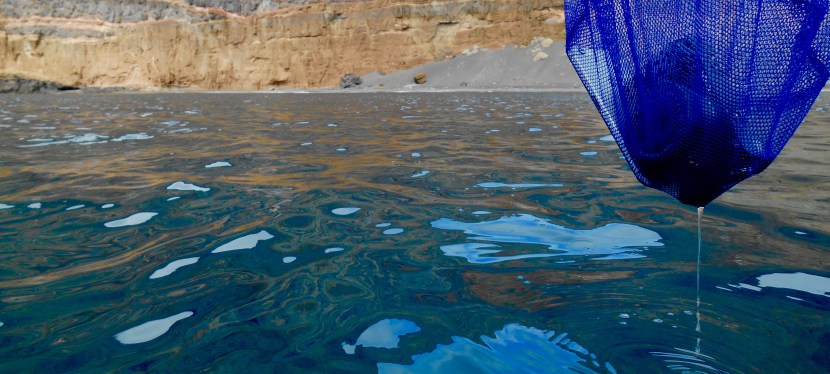
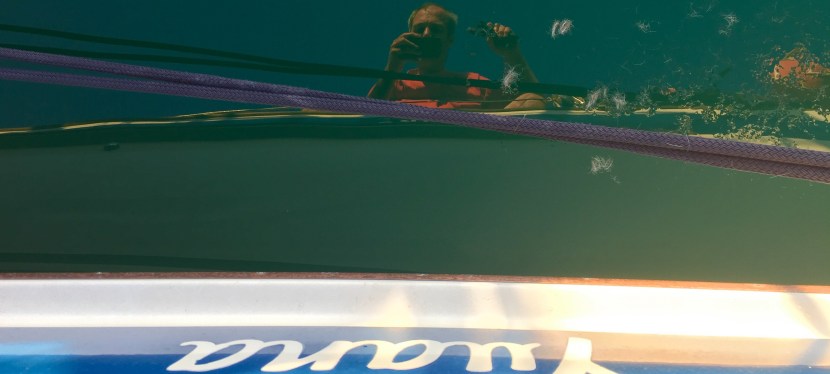
As there is no wind this morning, lets get it done right now, head over sea railings. The sea is so flat that it gives me a useful mirror. Check the picture. It is actually the highlight of this post. The grey flakes on the water would attract all kinds of fish. Of each size, the one called ‘Winkelried’ (a thoroughly heroic figure in Swiss history) takes the first bite. The first bite would also be the last one. And no other fish of same species would even try. To hairy, unpleasant experience as it seems.

Hair dressing is the only thing which is more efficient on sea than on land, at least looking at time and cost, perhaps not so much at the new look, haha.

Auf dem Wüstenschiff über den Vulkan

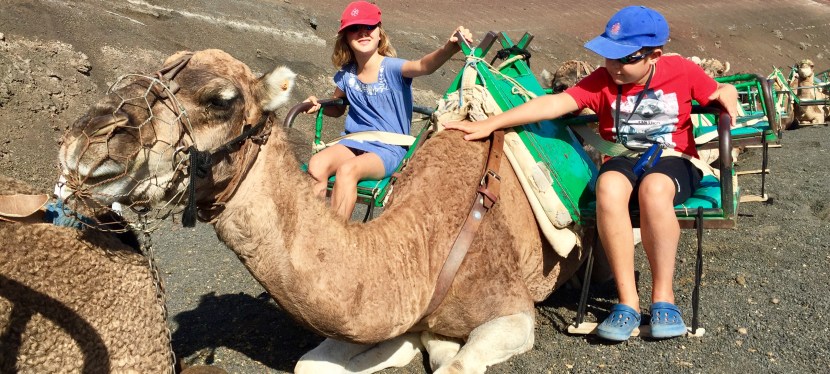
Für die kurze Zeit eines kurzen Ausfluges durch Sand und Felsen satteln wir von unserem Wasserschiff auf zwei Wüstenschiffe um. Man könnte sagen, dass sie mit ihren treuen Augen und weichen Mäulern geradezu niedlich aussehen (siehe Bild!), auch wenn dieses Attribut mit ihrem Lebensraum genauso wenig zu tun hat, wie ein Segelschiff mit der Vulkanwüste auf Lanzarote.

Zunächst aber besuchen wir eines der bedeutendsten Lavafelder weltweit, den Nationalpark Timanfaya. 1730 und 1824 ist es hier letztmalig zu riesigen Eruptionen gekommen, welche teils über sechs Jahre angehalten haben. Nachdem man im Drive-Thru Stil eingecheckt und sein Auto auf einem der Vulkankegel abgestellt hat, wird man im modernen Reisebus auf abenteuerlich geführten Strassen durch das Vulkangebiet gefahren. Ein bequemeres Museum haben wir noch nie gesehen! Die Landschaften sehen nicht so aus, als würden sie zu dieser Welt gehören. Aus der Nähe betrachtet geben die einzelnen Lavabrocken und Höhlen zuweilen sogar einen grotesken Eindruck ab. Die nun erstarrte, einst flüssige Gesteinsmasse kann einem durchaus an die selbstverständlich in-existenten Giessunfälle in einem Stahlwerk erinnern.

Das Besucherzentrum auf dem Parkplatz-Kegel gibt eine gute Vulkanshow ab. Über einem ziehbrunnen-artigem Loch – in einigen Metern Tiefe ist es 800 Grad warm – brät das Restaurant seine Pouletbeinchen. Die haben hernach sicherlich einen rekordhohen Anteil an Schwefel, und was sonst noch alles in pyroklastischen Dämpfen enthalten ist. Nichts für uns. Gleich nebenan haben sie eine Art Schweizer Milchkannen im heissen Boden eingegraben. Schüttet man oben 5 Liter Wasser rein, so verdampfen diese auf den vulkanisch aufgeheizten Milchkannenböden in der Theorie schlagartig zu 8000 Liter Wasserdampf. Diese Menge hingegen hat in unserer Milchkanne niemals platz. In der Praxis gibt das die schönsten Geysire ab, und alle wundern sich, wie das geht, haha. Du weisst es nun ;-).

Von Scania und Neoplan wechseln wir auf Mariaa und Vulcán. So nämlich heissen die beiden Wüstenschiffe, welche uns bei starkem Wind über den heissen Sand schaukeln. Um die Namen der Tiere festzustellen nestelt der Kamelführer – wir nennen ihn mal Abdullah – im krausen Fell am Hals dieser schönen Tiere herum. Wie er dort tastend die Namen fühlt, eröffnet sich uns nicht. Jedenfalls gewinnen wir den Eindruck, dass Abdullah eine ähnlich innige Beziehung zu seinen Tieren haben muss, wie ein Schweizer Bauer zu seinem Bruno und seiner Fiona.

Mariaa und Vulcán mögen es, wenn man sie (im Liegen) hinter den Ohren krault und über den Augen streichelt. Um mehr davon zu haben drücken sie sich etwas gegen die Hand, so wie Katzen dies auch tun. Wie der Katzenkopf geht dabei der Kamelkopf nach oben, allerdings gleich 1 Meter, weil der Hals eben viel länger ist.

Wie Wasserschiffe sind Wüstenschiffe gleichmässig zu beladen. Sitzt auf einer Seite ein Kind und auf der anderen ein Erwachsener, so wird die Kinderseite zusätzlich mit einigen Sandsäcken beladen. Wie ein solches Tier aus dem sitzen und mit 40% seines Eigengewichtes beladen aufsteht, ist ein Schauspiel für sich. Jedenfalls weist Abdullah uns an, sich mit beiden Händen am Sitzgestell gut festzuhalten. Wohl geraten! Abwechslungsweise und ruppig geht es hinten und vorne hoch und höher, bis die Tiere stehen.

Während dem Ritt über die vulkanischen Sandhügel stellt man sich gerne auf einer Kamelreise vor, durch die Sahara, von Oase zu Oase und von Dattelpalme zu Dattelpalme (für das leibliche Wohl will ja auch gesorgt sein)! Dann staunen wir wieder hinunter zu den Füssen der Tiere. Passend zum Fussabdruck nennt unser Sohn diese Quadratlatschen. Der Fuss ist eine grosse, plastische Masse (die Kamele gehören zu den Schwielenfüsslern). Sobald der Fuss abgesetzt ist, drücken die Fussknochen sanft diese behaarte Schwiele breit, und man fragt sich, warum diese Wüstenschiffe trotz der weichen Füsse eigentlich so stark schaukeln? Es kommt wohl daher, dass die Mariaa’s und Vulcán’s dieser Erde ihre Vorderfüsse im Gehen sehr ruckartig entlasten.

Zu bald schon ist die Tour zu Ende. Abdullah muss seine Tiere regelrecht beschwören, sich wieder hinzulegen: “Couche…!” “Couche…!”, eins nach dem anderen. So spektakulär wie es hinauf ging, geht es nun wieder herunter. Sobald ich festen Boden unter den Füssen spüre springe ich auf, um den ‘Hinlegevorgang’ des Kamel mit unserem beiden Kiddies zu filmen. Abdullah bedauert das sehr, denn nun ist Vulcán lediglich noch einseitig mit meiner Frau beladen. Ich muss mich wieder hinsetzen, damit wir erneut gemeinsam aufstehen können. Nun gut, der Höcker steht noch gerade, und das Dromedar sieht nicht besonders verärgert aus.

Ahoi, Kamel!

Madeira and Porto Santo

Oh, how have we enjoyed these two islands! As we found Porto Santo to be a generally dry and earthy brown place from the beaches up to the mountain tops, the southern coast of Madeira provides all kinds of tropic flavors, including fruits, flowers and mosquitoes.

The entire Madeira archipelago is of volcanic nature. Today, it is only a fraction of what it used to be, approximately 1 million years ago. When the archipelago found its maximum extension it was as long as 1400km! Most of it has eroded and washed away by the sea. In fact and when sailing down from Lisbon, we passed several under water mountains, one peaking just 20 meters below sea surface.

Porto Santo was commercially used already half a millennium ago. By then the so called dragon trees were milked. Their red ‘blood’ was shipped to Milan in Northern Italy, where the clothing industry was eagerly seeking the red color for the fashion business.

Our days in Porto Santo peacefully started at the harbor cafe with a great espresso against 60 cents. After our school lessons we would play at the nearby beach with its healing sands, and enjoy swimming in the sea every day. We explored the island with two Quads, which are the motor bikes with four wheels. Wooaaou, it was fun for the boys crawling up and down some rocky mountains and drifting along sandy trails.

The next best place after the beaches and some hexagonal volcanic columns was restaurant Torres in the tiny village of Camacha. Go there if you can, roasted chicken stands out. We were seated in the garden, sun protected by a huge passion fruit tree. I ordered a drink which was not on the menu list, particularly a tall glass of fresh passion fruit juice. Imagine how many fruits this would take. The price for it was 5 Euro and so I decided that it would be impolite to order a second one.

It was just a short 40 miles ride to the main island of Madeira. Different world, colorful all over, with up to three huge cruise ships tied up to the Funchal quays. The market hall offered a huge variety of local fruits and veggies, best presented and well marketed at a ridiculous price.

We visited tropical gardens, volcanic caves, natural swimming pools at the sea and a museum about whales and whaling. That made it quite easy for us to cover some aspects about school requirements.

The best thing for us on Porto Santo and Madeira however was that we really touched down with the blue water sailing community. Everyone in the harbor is traveling with his or her boat for a good time of the year. Many of them would pass the Atlantic Ocean this season. What however made this community so outstandingly great was that most different people with all kinds of social and business backgrounds meet. All of them are down to sailing and have a common theme which starts when helping each other with the mooring lines upon arrival. We were neighbored not only to kids from various countries, but also to a business lady from the Caspian Sea, doctors of medicine from France, financial investors from Norway, an oil exploration engineer from the other side of the world or a Swedish manager from an internationally acting Swedish furniture company. There are also cruisers who live their way around the globe on a very tight budget. That opens up such an entirely wide field of exchange. When saying “Good bye for now!” and wishing “Fair winds!”, we also say “See you in the West Indies!” or exchange invitations to visit each other at their homes around the globe.

Before leaving Portugal for some time, we shall not forget to mention how easy it was for us to communicate with the locals. Even the bus drivers were fluent in English as far as their job required it. The lady from the bread counter in the supermarket was not shy to interrupt a colleague, just to explain to us that the reddish color of the bread comes from the beet root juice they would add. Lots of charming people, nature and culture. Great place indeed.